Throughout our walk with the Lord, we will arrive at many crossroads. We will have to make many decisions and learn many lessons. Some may bring happiness, others regret. Nevertheless, we can all agree that life’s decisions are seemingly never easy. This week, I want to encourage us all to ponder a question that will confront each of us at one point or another throughout our journey. A question that we could actually ask ourselves daily. A question that we’ll come to find is not just a question, not just a decision to be made, but a perspective to be adopted. It is probably appropriate that we confront this question before it confronts us. So, the question is Nineveh or Tarshish?
This is a question that came to me upon reading the Book of Jonah. About a year ago, I felt drawn to read the Book of Jonah. I brushed it off for a couple days because I thought I knew the story of Jonah and the whale from watching a VeggieTales movie about it when I was a kid. Not being able to shake the drawing, I opened my Bible to the Book of Jonah and began reading. While I was nearing the second chapter, the question came to me. During this time, I was at a crossroad myself and needed to hear that question. So, if you’ve never actually read the Book of Jonah, I encourage you to do just that. Read it, study it, and meditate on it. There is so much more to glean from reading that book than what I am able to write about, so please, read it for yourself. Just like the rest of God’s Word, it is life-changing!

Nineveh
By reading the scripture, we come to know that Nineveh was not a good place. We know that they’d become a wicked city, probably not pleasant, and we know that Jonah did not want to go cry out against it even though the Lord told him to. We can arrive at the conclusion that even given Nineveh’s wickedness, unpleasantness, and Jonah’s lack of desire to go, that Nineveh was God’s will for Jonah at that given time.
So, if God told Jonah to go to Nineveh, Jonah knows that it’s God’s will for him to go, why wouldn’t he just go? There are many possibilities that we can come up with as to why he wouldn’t just go. One reason could be fear. Jonah knew that Nineveh had become wicked and he didn’t want any part in that. Another reason could very likely be (after reading chapter four and catching a glimpse of Jonah’s mindset) that he was not happy about the possibility of God giving Nineveh grace and showing them mercy. Then, maybe Jonah perceived this command as an inconvenience. Maybe he had other intentions or plans and going to Nineveh would disrupt what he thought was more important. Maybe it was all the above, we don’t know for sure. What we do know for sure is that Jonah doing things his way led to something that he most definitely was not prepared for.
Sometimes, it’s hard for us to understand that when we grow closer to God, Nineveh is somewhere that we will eventually have to arrive. The truth of the matter is, though, that God doesn’t always call us to the easy places. He doesn’t always call us to do the easy tasks. Nineveh, for us, can look like a lot of things. Our Nineveh may be that we need to forgive someone who painfully betrayed us or hurt us severely. It may be that we need to share God’s Word with someone at the store or at our workplace. It may be that we need to step into a role or responsibility that we feel unqualified for. Regardless of where God sends us or what He sends us to do, it is important to remain faithful. Whatever our Nineveh might be, we must surrender and act in obedience, because Tarshish is not the answer.
Tarshish
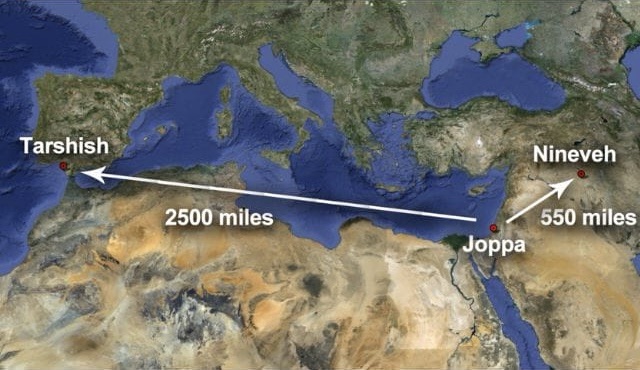
While it’s true that God gives us free will to make our own decisions, it is as equally true that our free will does not cancel out the consequences of avoiding God’s will. There is no doubt that Tarshish appealed to Jonah because it was a great distance away from where he knew that he was supposed to be. Jonah likely thought that he was pursuing peace and contentment in avoiding the wickedness and sinfulness of Nineveh by attempting an escape from what God had commanded him to do.
Though Jonah never made it to Tarshish, he certainly tried. Jonah 1:3 tells us that when Jonah rose up to flee unto Tarshish, he went down to Joppa and found a ship that was bound for Tarshish. Jonah paid the fare and went down into the ship. Not only did Jonah attempt to flee from the Presence of the Lord, but he paid (the fare) to do it. As we read on through chapter one, we find out that Jonah’s disobedience quickly placed others in danger as well. We read that the Lord sent a storm to the sea. The shipmaster went to get Jonah and told him to rise up and call upon his God so that they wouldn’t die in the storm. The others on the ship, being placed in danger by Jonah’s disobedience, came to know that Jonah was the reason behind the storm, so they asked him what could be done to calm it. Jonah told them to cast him into the sea and the sea would be calmed. To keep from throwing Jonah overboard, they tried to get the ship to shore but they couldn’t. So, they cried unto the Lord, asking Him not to hold them accountable for Jonah’s death and then they tossed him overboard and the sea became calm. Jonah 1:17 tells us that the Lord prepared a great fish to swallow up Jonah and Jonah stayed in the belly of the fish for three days and three nights.
Even though we may be tempted with Tarshish, we have to remember that it only leads to destruction. When we go to Tarshish, we may not literally board a ship and try to get there, but we often take steps that lead us further from what God has for us to do, simply trying to evade His purpose for us. Tarshish, for us, can look like trying to stay busy with other things rather than obey God’s command. It can look like choosing comfort rather than our calling. Or silence instead of witnessing, delay instead of surrender. Whatever our Tarshish may look like, we have to remember, like I said previously, choosing our free will rather than God’s will does not cancel out the consequences of doing so. If we do go after Tarshish, we may find ourselves in a storm or, worse, in the belly of hell.
The Belly Of Hell
In Jonah 2:1-2, we find that Jonah prayed to God from the fish’s belly. Jonah says that he prayed to the Lord out of the belly of hell and God heard him. Three days and three nights inside a large fish does not sound very accommodating, but, as we’ll see, it was vital to Jonah’s growth.
I can think of many times when I’ve felt as if I was in Jonah’s position. Being in that place is not fun. It’s very uneasy and, frankly, it feels awful. One instance from a couple years ago that I share about often is being in a prayer service and noticing a man wearing a bright orange shirt. I felt an overwhelming need to go pray with this man, but it was nearing the end of the service and I didn’t want to be the one to prolong it. Everyone was finished praying and was returning to their seats. Another man, who I hadn’t even noticed the entire evening, stood up in front of everyone and called that man up to the front of the room so he could pray with him. When he did that, I knew exactly what had happened. Nobody else in the room knew what had happened, but needless to say I learned my lesson. After the man prayed with the gentleman in the orange shirt, he called for others to come up and join him in prayer for this man, so I ran up there quickly. Turns out the man had received a cancer diagnosis a couple days before the service and was to return to the doctor the next day to receive a new scan to figure out a treatment plan. When he returned, there was no cancer and the scans were just days apart. Only God can do such things. But, I ran towards Tarshish with fear of keeping everyone just a few minutes later. I had to do some repenting. Nineveh may not have been appealing, but it would’ve been much better than trying to get to Tarshish, and, in retrospect, it’s a lesson that I needed to learn. While I am beyond thankful for the obedience and the boldness of the other man, wondering what would’ve happened if he, too, ran toward Tarshish still consumes me from time to time.
When Jonah prayed unto the Lord from the belly of the fish, he honored the Lord deeply, which led ultimately to his deliverance. Because I cannot paraphrase his prayer and capture its power, I will just include it. Jonah chapter two says:
“Then Jonah prayed unto the LORD his God out of the fish’s belly, and said, I cried by reason of mine affliction unto the LORD, And he heard me; Out of the belly of hell cried I, And thou heardest my voice. For thou hadst cast me into the deep, in the midst of the seas; And the floods compassed me about: All thy billows and thy waves passed over me. Then I said, I am cast out of thy sight; Yet I will look again toward thy holy temple. The waters compassed me about, even to the soul: The depth closed me round about, The weeds were wrapped about my head. I went down to the bottoms of the mountains; The earth with her bars was about me for ever: Yet hast thou brought up my life from corruption, O LORD my God. When my soul fainted within me I remembered the LORD: And my prayer came in unto thee, into thine holy temple. They that observe lying vanities Forsake their own mercy. But I will sacrifice unto thee with the voice of thanksgiving; I will pay that that I have vowed. Salvation is of the LORD. And the LORD spake unto the fish, and it vomited out Jonah upon the dry land.” –Jonah 2:1-10
The Second Time
One of my favorite scriptures comes from Jonah chapter three. Jonah 3:1-2 says, “And the Word of the Lord came unto Jonah the second time, saying, Arise, go unto Nineveh, that great city, and preach unto it the preaching that I bid thee.” When the Word of the Lord came unto Jonah for the second time, telling him to go to Nineveh, he went. He cried out against it and they repented and God had mercy on them. It is amazing what obedience can do. Even more amazing than that, though, is that God is, in fact, a God of second chances.
I can look back and remember many times when God has given me chance after chance and I cannot thank Him enough. Something else that we can all be thankful for is that Jonah’s attempt for Tarshish did not cancel God’s calling on his life. If it did, wouldn’t we be in a mess? God sent a storm to confront him because He refused to let Jonah drift permanently away from His purpose. Sometimes the storms in our lives function the same way. They interrupt our plans, expose our disobedience, and redirect our path. God loves us far too much to throw us away after our mistakes.
Why Choose Nineveh?
When we consider Jonah, we see that he took the long way around doing what God wanted him to do. It caused him a lot of undue tribulation. So, that would be the first reason I’d say we should choose Nineveh.
The second, is simply because of what Jonah 1:2 says. “Arise, go to Nineveh, that great city, and cry against it; for their wickedness is come up before me.” Someone somewhere seen fit to bring Nineveh’s wickedness before the Lord. It was someone’s prayer that Nineveh be called to repentance. How many times have we prayed for our lost loved ones? How many times have we asked others to pray for our lost loved ones? How many times have we prayed and asked God to tend to an issue that is beyond our means to resolve? Wouldn’t it be something if our disobedience knocked someone out of an answered prayer? That brings me to my final point.
We are not called to do what we are called to do just for us. Our callings are for others and to God’s glory. When we surrender to God’s will for our lives, we cannot give him restrictions. We cannot agree to do only the things that we want to do. We must surrender to and obey Him regardless of how it looks, how it feels, how it smells, or how it makes us look.
Just as I have to ask myself regularly, I ask you, Nineveh or Tarshish?
Let us all surrender to God and to His will for our lives today, and everyday.

 The Faithful Surrender
Leave a comment